Beijing Roast Duck: Order the Duck and Understand the Accompaniments
A Beijing roast-duck meal often involves more than a plate of sliced meat. Skin, meat, pancakes, vegetables and condiments create different mouthfuls, while the order itself may have several parts. Clarify what the restaurant serves before assuming a single menu price describes the entire meal.
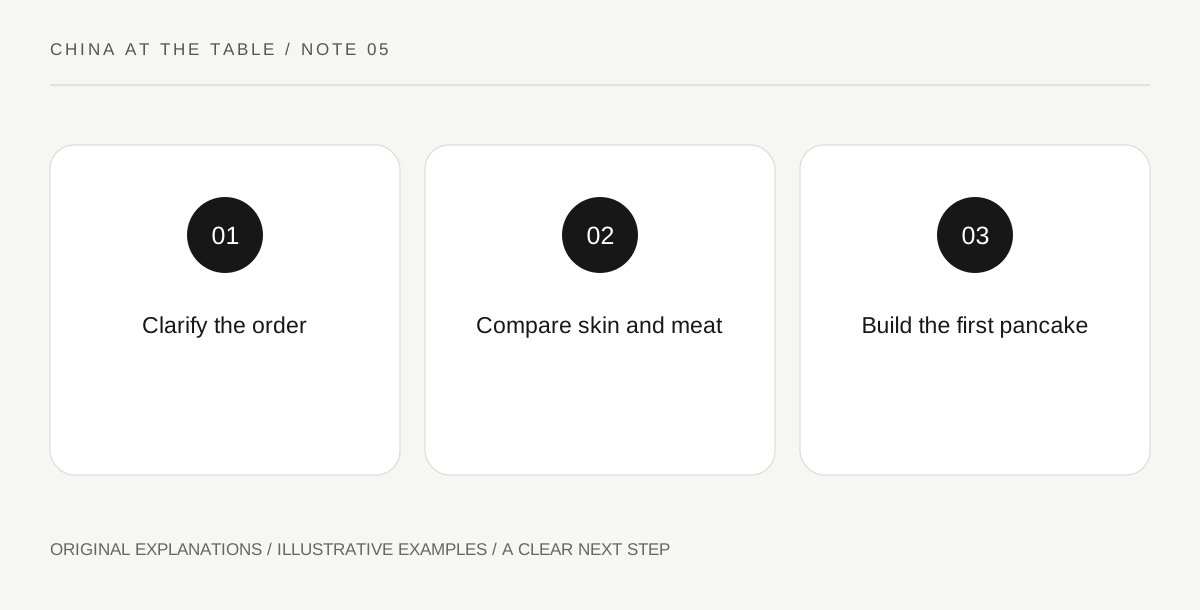
Original explanatory diagram. Read the full method and limitations below.
Ask what the stated portion includes
Read whether the menu offers a whole bird, a smaller portion or a set. Then ask which accompaniments come with that order and which are charged separately. Do not infer a universal serving count from the phrase one duck, since appetites, other dishes and the restaurant’s presentation differ. If a soup or further preparation of the bird is offered, clarify whether it belongs to the set or is an optional item. This is particularly helpful for a small party that wants to try the duck without ordering a banquet by accident. An itemized explanation is more useful than a generic portion recommendation.
Notice the distinction between skin and meat
Beijing tourism’s serving account emphasizes crisp skin and the effect of slicing on texture. Use that distinction as a tasting question: what changes between a small piece of skin, a slice with meat and a wrapped mouthful? Let the restaurant explain its own presentation rather than assuming a particular carving sequence is mandatory everywhere. A dramatic tableside service can be interesting, but the real comparison is in the food on your plate. Avoid ranking an entire cooking tradition from one visual impression or claiming that a specific color alone proves how the duck was roasted.
Build a modest first pancake
The documented serving format includes a flour pancake with sauce, duck and vegetables. Begin with a manageable amount so the filling stays within the wrapper and you can notice its different textures. If several condiments are supplied, identify them before combining everything. Ask which sauce the restaurant offers rather than calling all brown condiments hoisin. Try a smaller quantity first; adding more later is easier than recovering the texture of a mouthful overwhelmed by sauce. This is a practical tasting method, not an etiquette test requiring every diner to assemble an identical wrap.
Separate a cultural format from your dietary decision
A familiar duck label does not tell you everything about sauces, pancakes or accompanying dishes. Ask about those components if you need ingredient information. Keep sharing utensils and individual eating utensils organized according to the restaurant’s guidance. When comparing experiences, record the restaurant’s declared style, the components supplied and what you actually observed. Do not invent an origin story from the presence of a particular pancake or declare that a meal is inauthentic because it differs from an overseas version. Chinese food categories contain regional and establishment variation, and useful notes acknowledge the specific setting of the comparison.
Illustrative small-party order
Three diners ask whether the displayed duck portion includes pancakes and condiments, and whether an offered soup is extra. They choose one duck order alongside a separate vegetable dish. Each builds a small first wrap and compares skin, meat and accompaniment. This is an ordering scenario with illustrative party size, not a claim about how many people a bird must feed.
Practical checks
Optional checkboxes save only in this browser.
Questions that come up
Is every brown duck sauce the same product?
No. The restaurant’s condiment should be identified directly. A color or a familiar overseas name is not enough to establish its ingredients or exact style.
Does a whole duck automatically include soup and unlimited pancakes?
Do not assume that. Read the current menu and ask what the order includes. Portions, sets, accompaniments and optional preparations belong to that establishment’s offer.
References and scope
These sources support the factual background. Examples and exercises are original illustrative teaching material. References do not imply endorsement.
- Beijing tourism: roast duck — Roast duck presentation and accompaniments; not a restaurant review.