Xi’an’s Bread Dishes: Tell Roujiamo From Paomo
Xi’an’s food vocabulary includes both bread holding meat and bread becoming part of a soup. Roujiamo and paomo therefore offer a useful contrast in structure, even when English descriptions reduce them to hamburger and pita. Read what the bread is doing before expecting the same meal.
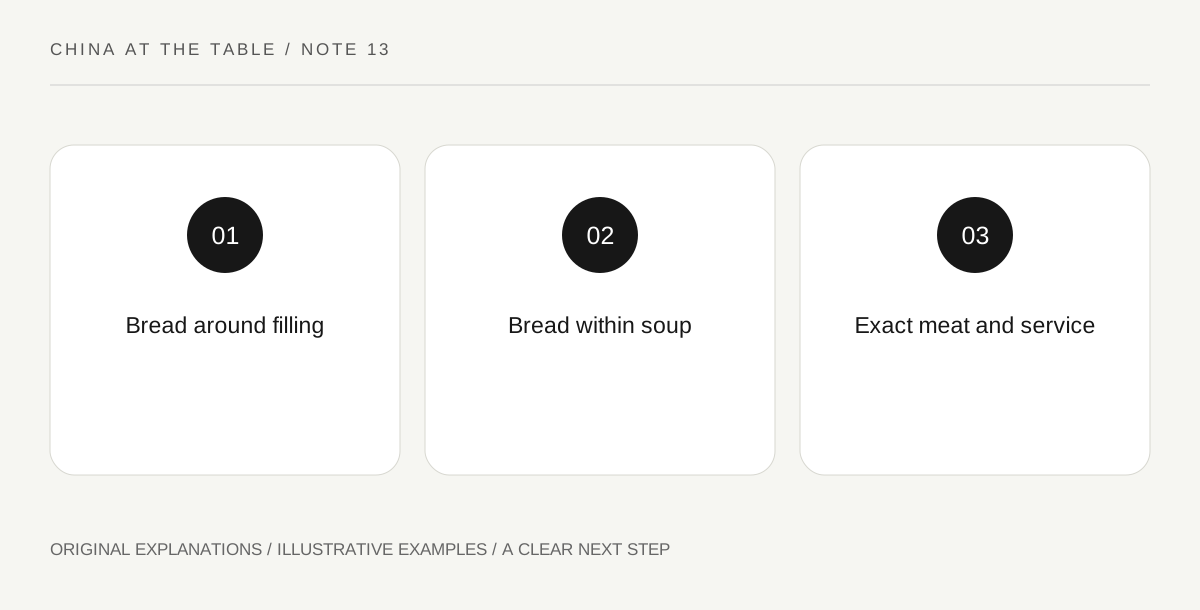
Original explanatory diagram. Read the full method and limitations below.
Use the bread’s role to distinguish the names
Xi’an’s municipal material describes lazhi roujiamo as marinated meat with Baiji bread and paomo as bread soaked in meat soup. The structural distinction is clear: one contains a filling in bread, while the other incorporates bread into the bowl. That is a more useful first memory than deciding which Western food is the exact equivalent. Keep the Chinese names with a short explanation rather than replacing them permanently with burger or pita soup. A familiar comparison can make an unfamiliar dish approachable, but it should not erase the food’s own identity or make you expect the wrong texture.
Read the meat with the particular item
Different municipal descriptions mention different meat contexts in Xi’an’s food scene, so the broad roujiamo label should not be treated as a universal pork or beef guarantee. Ask what the exact item contains and whether the filling has additions you need to know about. Likewise, a paomo name may specify mutton or another meat soup. Point to the complete menu line rather than asking for the bread dish you saw elsewhere. The main ingredient and preparation belong to the named order, not to an assumption based on the neighborhood or the appearance of the stall.
Notice how the bread changes the eating experience
For roujiamo, compare bread and filling in the same mouthful rather than tasting only loose meat from a wrapper. Ask how the outer bread texture relates to the moist filling you receive. For paomo, follow the restaurant’s explanation of its service and notice how the bread contributes to the bowl. If the establishment asks diners to participate in preparing bread pieces, ask for guidance on that specific procedure. Do not assume a ritual from a travel video applies to every restaurant or that a first-time visitor must perform it without help to earn an authentic meal.
Build a comparison that does not require ordering everything
A small party may want to learn both forms, but appetite and portion sizes determine whether that is sensible in one sitting. Inspect the current menu and ask whether sharing is practical. You can also compare them across separate meals, keeping brief notes on bread form, declared meat and broth or filling. Avoid adding a third famous starch simply to complete a checklist. A useful food memory records what makes each structure distinct and where you encountered it. It does not claim that one shop represents all Xi’an food or that a nickname determines the dish’s complete history.
Illustrative two-meal comparison
At lunch, a visitor orders a clearly described roujiamo and notes bread around a moist meat filling. On another day, the visitor tries a named paomo after staff explain the service, then records bread as part of the soup. The comparison uses structure, meat and presentation. It does not assume identical meat in the two orders or a compulsory bread-breaking ritual.
Practical checks
Optional checkboxes save only in this browser.
Questions that come up
Is a Chinese hamburger an exact description of roujiamo?
It is an introductory analogy used in tourism material, not a complete equivalence. Keeping the name roujiamo alongside bread and filling makes the identity clearer.
Does paomo mean the same thing as a meat sandwich?
No. In the cited Xi’an material, bread is incorporated into a meat soup. That creates a different structure from bread holding a filling, even when both dishes appear in the same local food guide.
References and scope
These sources support the factual background. Examples and exercises are original illustrative teaching material. References do not imply endorsement.
- Xi’an municipal food introduction — Roujiamo, liangpi and local noodle identity; no claim of firsthand tasting.
- Xi’an: marinated meat in baked bread — Lazhi roujiamo and Baiji bread as a named local combination.