Read a Chinese Menu by Cooking Verb: Steam, Stir-Fry, Pan-Fry and More
A few cooking verbs make a Chinese menu easier to navigate because they describe what happens to an ingredient. They do not reveal the whole recipe, but they help separate similar-looking names. Learn the character, its broad technique and the limits of what that clue can tell you.
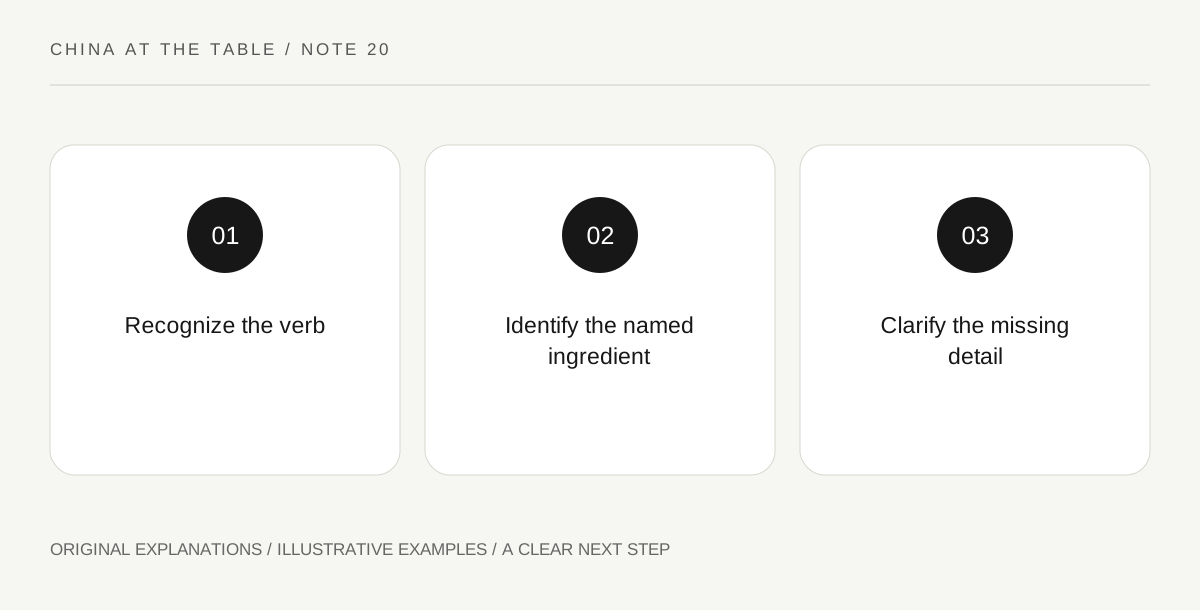
Original explanatory diagram. Read the full method and limitations below.
Begin with steam and boil as different clues
蒸, zhēng, points toward steaming, while 煮, zhǔ, points toward cooking in liquid or boiling in the cited vocabulary guide. Learn the characters alongside the pronunciation so you can recognize them even when a transliteration varies. Read the following ingredient as a separate part of the name. A steaming term tells you something about technique, not whether the filling contains meat or what sauce is added afterward. Similarly, a boiling-related word does not establish a plain or lightly seasoned dish. Use the verb to form an informed question rather than to predict every aspect of the final plate.
Distinguish the different English meanings of fried
炒, chǎo, refers to stir-frying; 煎, jiān, to pan-frying; and 炸, zhá in this cooking sense, to deep-frying. English menus can shorten all three to fried, obscuring useful differences. When two dishes have similar translated names, compare the Chinese characters to see whether a different technique is being named. This does not allow you to calculate oil content or declare a meal healthy from one word. It does give you a more precise description of the preparation family and may explain why a dish is tossed in pieces, browned on a contact surface or enclosed in a crisp shell.
Add roasting and tossing without over-translating
烤, kǎo, covers roasting or baking in the guide, while 凉拌, liángbàn, indicates a cold-tossed or mixed preparation. The exact English wording depends on the dish, so keep the character with a short explanation rather than forcing every term into a single rigid English equivalent. A cold-tossed item may contain ingredients that were previously cooked. A roasting word does not specify the appliance, fuel or full sequence. Regional dish names can also preserve conventions that are more specific than a beginner’s glossary. Let the menu and kitchen supply that next layer of meaning.
Build a three-part menu note
For an unfamiliar line, write technique, named main ingredient and unresolved question. The question might concern filling, sauce, serving temperature or whether the dish is shared. This method prevents a translation app from turning one recognized character into false confidence about the whole item. Practice on a few actual menu lines and compare with the restaurant’s description. Do not treat a vocabulary lesson as a tested cooking instruction or use it to infer safe preparation times. The success criterion is being able to distinguish two orders and ask a focused question, not translating every character on a large menu immediately.
Illustrative translation check
A diner sees two English lines both described as fried dumplings. One Chinese name contains 煎 and the other 炸. The diner asks staff to explain the difference in that kitchen, then confirms the fillings separately. The character recognition narrows the question while leaving portion, sauce and ingredients to the actual menu rather than an imagined universal recipe.
Practical checks
Optional checkboxes save only in this browser.
Questions that come up
Does a cooking verb reveal all ingredients?
No. It is a technique clue within a larger dish name. Fillings, sauces, stock, garnishes and preparation details still need the menu or kitchen’s explanation.
Does cold-tossed mean every ingredient is raw?
No. The format can include previously cooked ingredients. Read the actual dish description rather than treating the serving method as a complete history of each component.
References and scope
These sources support the factual background. Examples and exercises are original illustrative teaching material. References do not imply endorsement.
- Shanghai: Chinese cooking verbs — Menu verbs such as steam, pan-fry and boil; inconsistent example translation is not reproduced.