Chinese Tea Categories: Processing Names Before a Color Chart
A tea category is more informative than the color of a cup photographed online. China’s traditional processing practices include six broad categories, with many individual products within them. Learning how to ask about category, product and preparation gives a first tea conversation a clear shape without promising expertise from one tasting.
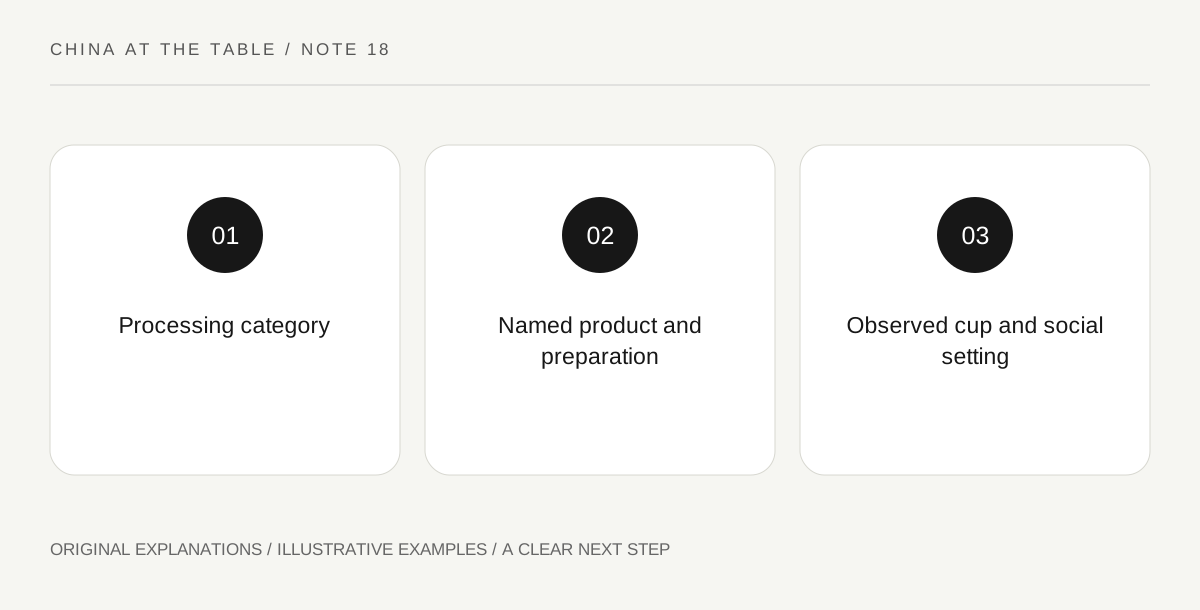
Original explanatory diagram. Read the full method and limitations below.
Use the six-category framework carefully
UNESCO’s account names green, yellow, dark, white, oolong and black teas within China’s traditional processing practices. Treat that list as an organizing framework rather than six colors that every brewed cup must match. A pale or deep liquor does not independently identify the category. Ask a seller for the product name and category in writing, and preserve any Chinese name on the label. This gives you something concrete to compare later. Avoid replacing the label with a guessed English color just because it resembles a tea you have tried before.
Separate category from named product
The same broad category can contain many products shaped by local practices. A label might highlight a place, style or producer as well as the category. Write those fields separately so a geographic association does not become an unsupported guarantee of origin or quality. If the seller makes a specific claim about where the tea was grown or processed, ask what information accompanies it. You do not need a prestigious origin to enjoy a tea, but a purchase description should distinguish the product’s actual documentation from an evocative landscape on its packaging.
Make the preparation part of the tasting note
Ask the tea provider how the specific product is being prepared and follow its instructions for the session. Record the amount, vessel and infusion information that the provider actually gives rather than inventing a universal setting for an entire category. Two cups prepared differently are not a controlled comparison of leaf alone. Notice aroma, flavor, texture and your own preference without assigning medical effects or ranking the tea’s value from one impression. If comparing successive infusions, label them clearly. The note becomes useful because it preserves what happened, not because it borrows technical-sounding words that you cannot connect to the experience.
Understand tea as a shared social practice
UNESCO’s description includes drinking, sharing and the transmission of skills through families and other learning relationships. That is broader than a formal ceremony performed the same way everywhere. When visiting a tea setting, follow the host’s explanation and ask about the particular practice rather than demanding a universal Chinese tea ritual. A workplace cup, family gathering and specialist tasting can each reveal a different context. Appreciate the social arrangement along with the leaf. Courtesy and curiosity are enough for a beginner; there is no need to pretend to recognize an age, mountain or processing detail that you have not established.
Illustrative label-and-cup note
A beginner records a tea’s printed product name, the seller’s stated category and the preparation demonstrated at the table. The note then adds two plain observations about aroma and mouthfeel, plus whether the drinker enjoyed it. A second tea gets the same fields. The comparison does not infer origin, health benefit or price from the color of the brewed cups.
Practical checks
Optional checkboxes save only in this browser.
Questions that come up
Can cup color tell me the tea category?
Not reliably on its own. Use the product’s label and a knowledgeable explanation of its processing category. Lighting, strength and preparation also affect appearance.
Is there one correct ceremony for all Chinese tea?
The heritage description includes many everyday and social settings. Learn the practice of the particular host or venue rather than assuming every cup belongs to a single formal ritual.
References and scope
These sources support the factual background. Examples and exercises are original illustrative teaching material. References do not imply endorsement.
- UNESCO: Chinese tea processing and social practices — Six processing categories and tea as a shared cultural practice.