Tangyuan: Read the Filling Before Calling Them Dessert
Tangyuan are often pictured as pale round glutinous-rice balls, but the appearance does not tell you whether the filling is sweet or savory. Their festive associations add another layer of meaning. Read shell, filling and serving liquid separately before deciding where they belong in a meal.
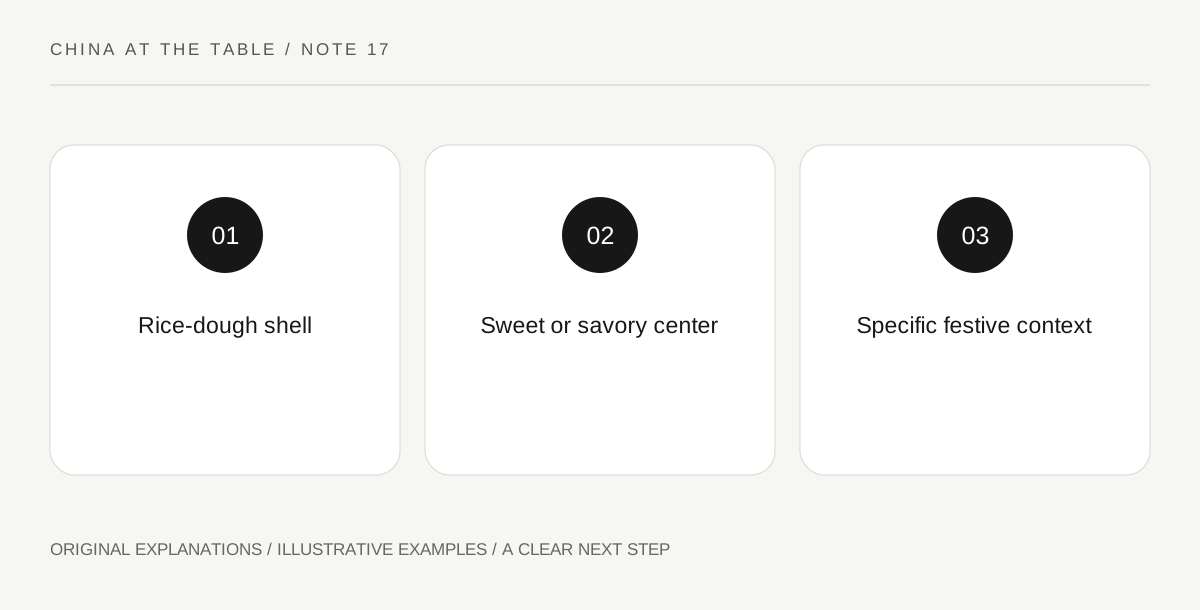
Original explanatory diagram. Read the full method and limitations below.
Identify the rice-dough shell and declared filling
Shanghai’s festive-food account describes soft glutinous-rice dough with a range of fillings. Sweet examples include black sesame, red bean and peanut, while savory versions can contain pork or other ingredients. The useful first distinction is therefore the filling rather than the round exterior. Point to the precise menu line and ask which version is being served. A pale surface cannot reveal whether the center is sweet, meaty or mixed. If buying a packaged product, read its label rather than assuming an illustration of a bowl supplies the whole ingredient list.
Keep the serving liquid in the description
A bowl can combine filled pieces with a surrounding liquid whose role differs from the filling. Ask whether the restaurant’s preparation is sweet, savory or otherwise seasoned and whether the liquid is intended to be eaten with the pieces. Do not decide from a clear appearance alone. In a comparison note, give shell, center and liquid their own short descriptions. This avoids collapsing the entire dish into one adjective such as chewy. It also helps you remember whether a surprising flavor came from the center, an added garnish or the medium surrounding the rice balls.
Approach the hot center as well as the surface
The outside can seem manageable while the filling remains hot. Use a suitable spoon or plate, let the food cool enough for comfortable eating and avoid treating an intact round piece as something that must be swallowed whole. Ask for help if unfamiliar with the restaurant’s presentation. The point is enjoying shell and filling together at a pace that suits you. This article does not provide home-cooking times or a doneness test for unspecified products. Packaged products and kitchens have their own preparation instructions, and a festival description is not a replacement for those instructions.
Describe reunion symbolism as a cultural association
The Shanghai account connects roundness with wholeness and family togetherness in its festive context. That association enriches the food without requiring every family to serve the same filling on the same occasion. Ask a host about their own tradition and let the answer remain specific to that household or community. Avoid assuming all Chinese celebrations share a single menu, or that a savory version must be a mistake because an overseas restaurant serves only a sweet one. Food traditions can carry recognizable associations while still allowing regional, household and contemporary variation. A careful description leaves room for both continuity and difference.
Illustrative menu comparison
A family orders a sweet black-sesame version on one occasion and encounters a savory pork version elsewhere. Their notes keep the same three fields: rice shell, declared center and serving liquid. Both can be understood as tangyuan without forcing them into one dessert category. A host’s reunion explanation is recorded as that family’s account rather than a compulsory national rule.
Practical checks
Optional checkboxes save only in this browser.
Questions that come up
Are tangyuan always sweet?
No. The cited Shanghai description includes sweet and savory fillings. Check the exact menu item rather than classifying every pale round rice ball as dessert.
Does the same filling appear in every family celebration?
No universal filling follows from the cultural association. Regional and household practices vary, so use the host’s explanation and the actual dish description instead of treating one example as the rule for everyone.
References and scope
These sources support the factual background. Examples and exercises are original illustrative teaching material. References do not imply endorsement.
- Shanghai: traditional New Year foods — Tangyuan filling variation, niangao and locally described festive associations.