Fish-Fragrant Pork: Why Yuxiang Describes Seasoning Rather Than Fish
An English menu saying fish-flavored pork can be puzzling if you expect fish to be the main ingredient. Yuxiang is useful to recognize as a Sichuan seasoning idea. Understanding the term helps you ask better ingredient questions without assuming that a poetic dish name is a complete recipe.
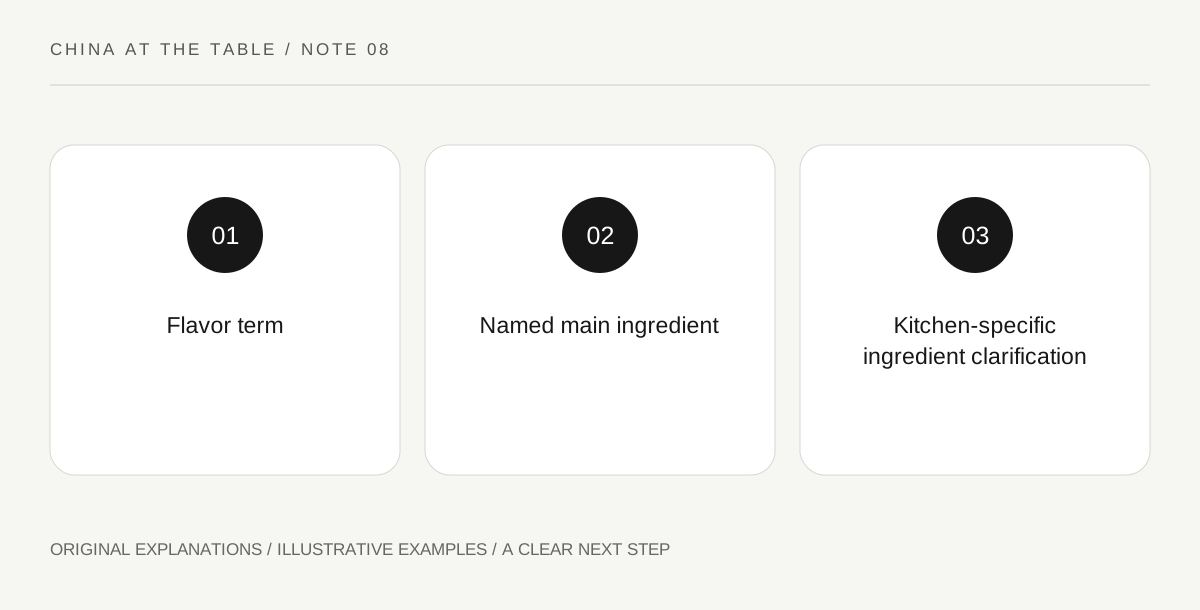
Original explanatory diagram. Read the full method and limitations below.
Separate the flavor name from the main ingredient
GoChengdu explains fish-fragrant dishes through a seasoning mixture associated with cooking fish, while its featured dish is shredded pork. That is enough to show why a literal English translation can misdirect a diner. Read yuxiang together with the following ingredient or dish name. The term provides a flavor clue rather than announcing a piece of fish on the plate. At the same time, do not reverse the mistake and treat the name as a guarantee that no seafood-derived ingredient can be present. Only the kitchen can explain the particular preparation served.
Use several flavor questions instead of one spice scale
The regional description lists aromatics alongside sugar, vinegar and chili in its account of the seasoning. For a diner, this invites a comparison of aromatic, sweet, sour and spicy impressions. Those dimensions can be present together rather than canceling one another. Ask staff how the house version is characterized if the menu gives no useful description. A dish can have chili without being defined solely by intensity. Noticing balance is more informative than judging the entire plate by the first hot sensation, especially if a companion has ordered a different Sichuan flavor profile.
Compare the cut and the sauce together
Shredded pork has a different relationship with sauce from a large piece of meat or a soft vegetable. Notice whether a mouthful includes a representative amount of the shreds and accompaniment. If comparing a yuxiang vegetable dish on another occasion, record the main ingredient as well as the flavor term; the same seasoning idea can create a different eating experience with another texture. Do not assume that similar names mean identical sauces across all restaurants. The useful comparison is between declared ingredients, shape and perceived balance, with uncertainty left visible where the kitchen has not provided details.
Keep translation assistance close to the actual menu
If you use a translation app, show the Chinese line and confirm the main ingredient with staff. A machine translation may turn a flavor term into a biological ingredient or simplify several different dishes into fish sauce. Avoid ordering from an isolated English phrase copied from another restaurant. If a dietary requirement is important, describe the ingredient you need to avoid directly rather than asking whether the dish is authentic yuxiang. Cultural classification and suitability are separate questions. A precise ingredient conversation is more useful than attempting to resolve a requirement through the traditional name alone.
Illustrative menu clarification
A diner reads fish-flavored shredded pork and asks whether the main ingredient is pork and what the seasoning contains. Staff explain their version. The diner notes aromatic, sweet, sour and chili impressions rather than expecting a fish fillet. A companion’s dietary question is asked separately, because the meaning of the traditional flavor name does not certify the complete ingredient list.
Practical checks
Optional checkboxes save only in this browser.
Questions that come up
Does yuxiang always mean the dish contains fish?
No. The cited regional explanation treats it as a seasoning style associated with fish cookery, while describing a pork dish. The actual ingredient list still belongs to the kitchen.
Can I assume fish-fragrant food is safe for a seafood allergy?
No. A flavor name is not an allergen statement. Ask the kitchen about ingredients, products and preparation relevant to the specific requirement rather than inferring safety from a translation.
References and scope
These sources support the factual background. Examples and exercises are original illustrative teaching material. References do not imply endorsement.
- GoChengdu: local dishes — Twice-cooked pork and yuxiang seasoning profiles; institutional regional food introduction.